
© 2019 Steve Campsall
Englishbiz Grammar Essentials |

Download free guides
to textual analysis
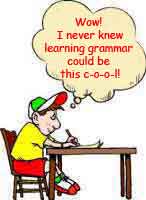
Well, maybe learning a bit of grammar is not seen to be cool these days, but here at Englishbiz we love it; and we'll do our darndest to make it interesting, easier and useful for your course. If you're studying for an A level in English Language, you'll find these web pages have been written with you in mind at all times. What follows in the next 20 or so pages is sufficient grammar for you to make subtle, mark-grabbing comments on all kinds of texts.
If you are not taking an A level, we hope that you'll still find it all useful!
Why Grammar is Important.
Remember that in any textual analysis you carry out, it is the effects created by the text's features (upon its original intended audience) that you are aiming to explain, along with the purpose intended.
When you are looking specifically at the effects created by a writer or speaker's grammatical choices, therefore, it is not merely enough just to label the grammar, but to choose important grammatical aspects worthy of being explained in terms of effect and purpose.
Each year many students barely mention grammar in their exam answers. Not you. You recognize the importance of grammar because it is one of the three linguistic choices we must make whenever we communicate:
Choices of words: lexis.
Choices of sentence types (or, in speech, utterance types): grammar.
Choices of the sequencing of sentences: discourse structure.
To ignore grammar would, therefore, risk missing a key linguistic aspect of any text.
The choices of words (lexis) and sentences (grammar) are referred to as lexico-grammatical choices.
If you are studying for an A level in English Language, there are two further v-e-r-y useful guides available on Englishbiz: here and here.
What
is
Grammar?
Language is our number one means to communicate what
is on our mind to another person or group of people. The need to communicate
arises as a response of an individual to their existing context,
one that needs to include an audience (either co-present, as in
conversation, distant as in writing, or imagined as in, for example, a media
text). A reaction to such a context creates a desire to achieve something
related to a particular topic, that is, a purpose
- a purpose related to the language user's attitude
towards the topic. All communicative acts can be summarised thus:
Individual + context (inc. audience) > topic > attitude > purpose.
But the actual creation of a text requires more. It requires, even if the text is a seemingly natural everyday conversation, a genre. Whenever we create a text of any kind, we need to follow certain genre conventions to form the text. An audience can only respond to a genre they know (okay, okay - post-modern and avant-garde writers can play with genre..!). Within the conventions of any genre, a great degree of latitude is allowed for the creation of a particular style. Style is what allows a language user to achieve his or her purpose for a particular audience. It is a combination of lexis, grammar and discourse structure which, although limited or restrained by the requirements of genre, purpose and audience, still allows for individuality.
Finally, for a discourse to be created, the audience need to respond to the text. This response need not be verbalised (i.e. it can be internal, for example, when we read a newspaper article); but the discourse in its entirety always includes both language users.
Grammar is the internalised set of rules or conventions for the creation of an individual sentence.
We learn the rules of grammar subconsciously as we learn to speak and write. It's been postulated that humans must be born with some kind of basic grammatical structuring which is a part of the way the mind works. The theorists Chomsky and Pinker call this 'deep grammar'.
Our knowledge and use of grammar becomes further refined as we develop as sophisticated speakers and writers.
Some of the more complex aspects of grammar cannot be picked up casually - they need to be taught and consciously learned at school.
Language users rarely need to consider their use of grammar except in a few very unusual or formal situations when we might be especially sensitive to making an error. Studies show that culture brings some women in particular to want to over-correct their grammar ('hyper-correction'), over-extending the rules and using, paradoxically, non-standard grammar. An example is the often heard, "Our thanks to you all from my brother and I on this splendid occasion". Do you know what the standard grammar would be? ("Our thanks to you all from my brother and me on this splendid occasion").
As a student of language, when you analyse and discuss key points of grammar in a text's sentences, as with all other analytical techniques, your aim is to make worthwhile comments, avoiding all self-evident stuff! This means considering how the grammar has been chosen in the light of the four basic linguistic aspects: genre, context, audience and purpose.

Pages updated 24 Sept 2019